AI agents vs agentic AI: understanding the terminology


Executive summary
AI agents and agentic AI aren’t synonyms, and confusing them costs organizations real money. Although there’s still some debate about the industry-wide definition, in Cloudflight, we describe an AI agent as a software component designed to handle a specific, well-defined task. Agentic AI, on the other hand, describes a broader system architecture, with the capacity for autonomous goal-setting and multi-step planning, which results in self-directed action.
The distinction matters now more than ever. Gartner predicts that over 40% of agentic AI projects will be canceled by the end of 2027, largely because organizations don’t really understand what they’re purchasing.
Key facts to keep in mind:
- AI agents are task-specific components; agentic AI is the orchestration architecture that puts them to work
- In 2025, fewer than 5% of enterprise applications included task-specific AI agents. For 2026, Gartner expects this figure to reach 40%.
- 23% of organizations are already scaling agentic systems; most are doing so in only one or two functions.
- Gartner explicitly flags “agent washing,” meaning vendors relabeling chatbots and robotic process automation (RPA) tools as AI agents, as a primary source of failed projects.
Bottom line: getting this terminology right is a prerequisite for making smart technology investments.
Why this terminology became so confusing
The terms arrived together and evolved in public. Andrew Ng helped popularize the word “agentic” in a 2024 lecture, right as large language models were becoming capable enough to support businesses beyond simple generative tasks. Vendors rushed to attach the word “agent” to every product in their catalog. By early 2025, the average enterprise AI pitch deck contained both terms, often interchangeably.
This linguistic collision has real consequences. Gartner analysts describe most agentic AI projects right now as “early-stage experiments or proof of concepts that are mostly driven by hype and are often misapplied.” Organizations end up expecting a single-task automation tool to solve complex, cross-functional problems it was never designed for. That leads to disconnected automations. Their logic is inconsistent, and their budget often overruns.
Luckily, you don’t need a computer science degree to understand the fundamental differences between the two terms. All it takes is to understand two distinct concepts: what an entity does versus what capability a system possesses.
What is an AI agent, and what it isn’t
Formally speaking, an AI agent is a computational system that maps observations of an environment to actions according to a goal-directed policy defined by its designer or training process. This might sound confusing, so let’s put it in more down-to-earth terms: it’s software designed to perceive input from its environment, reason about that input, and take action toward a defined goal. The critical word is defined. Someone specified what this agent is supposed to do, and the agent executes within those parameters.
The bounded nature of AI agents
AI agents operate inside explicit boundaries set by their design and permissions. For instance, a customer service agent can:
- look up order history.
- process refunds.
- route tickets.
It can’t decide to redesign the entire support workflow because it noticed a pattern in complaints. That decision falls outside its scope.
This doesn’t make agents weak or limited in a pejorative sense. A well-designed agent handling invoice validation, for example, can be extraordinarily reliable precisely because its scope is narrow.
A contained scope greatly reduces the risk of falling into the usual AI pitfalls. An AI agent doesn’t improvise or hallucinate instructions. It doesn’t decide on its own that it should also start handling vendor onboarding because that seemed related.
What actually qualifies as an AI agent today
The category is broader than many people assume. According to Anthropic’s guidance on building effective agents, an agent is a system “where LLMs dynamically direct their own processes and tool usage, maintaining control over how they accomplish tasks.” This is different from an LLM simply following a predefined script.
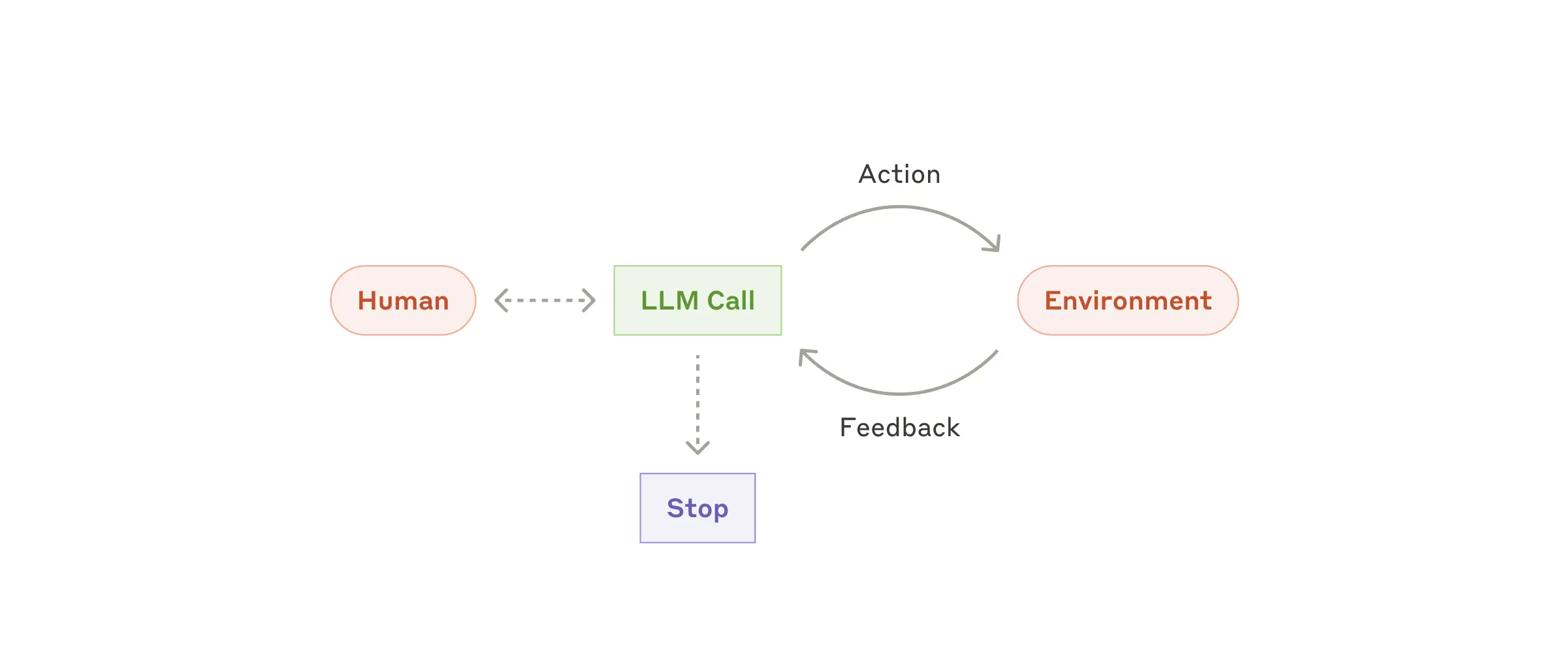
Image source: Anthropic
Practical examples of genuine AI agents include a scheduling assistant that checks calendar availability, resolves conflicts, and proposes alternatives, or a code review agent that reads a pull request to identify issues against a style guide and lists them out in comments. Both perceive an environment to reason and act. Both are bounded by what they were designed to handle.
What doesn’t qualify as an AI agent is, for instance, a traditional chatbot that picks from a menu of pre-written responses. A form-filling macro also doesn’t make the cut because it doesn’t reason. Dangerously, these are the systems that often get relabeled as AI agents in sales pitches.

What is agentic AI
To start with, it’s important to stress that agentic AI isn’t a product but a capability. More precisely, it’s the architectural property of a system that can pursue complex goals with a meaningful degree of autonomy, for instance:
- setting sub-goals.
- planning sequences of actions.
- adapting when conditions change.
- coordinating multiple agents to get there.
The four defining characteristics of agentic AI
Research from Cornell University, published on arXiv in May 2025 and updated through September, describes agentic AI systems as architectures characterized by persistent memory, dynamic task decomposition, multi-agent collaboration, orchestration, and coordinated autonomy. These properties aren’t presented as a strict list, but as recurring architectural features that distinguish agentic AI from single-agent systems.
- Persistent memory. The system retains context across sessions and uses past interactions to inform current decisions. Not just a conversation history, but structured knowledge that shapes future behavior.
- Dynamic task decomposition. When given a high-level goal, the system breaks it into sub-tasks, decides which tools or agents handle each, and sequences the work. This decomposition isn’t pre-programmed – it happens at runtime based on the specific goal.
- Multi-agent orchestration. The system coordinates specialized agents, each handling a domain, while maintaining coherent progress toward the broader objective. An orchestrator layer connects them.
- Coordinated autonomy. When something doesn’t work – an API returns unexpected data, a step fails, new information changes the situation – the system adjusts its approach rather than halting or escalating to a human immediately.
What agentic AI looks like in practice
Consider the difference between the two approaches to a customer cancellation event. A single AI agent processes the event within its assigned scope: it records the cancellation, updates the CRM, triggers the predefined follow-up workflow, and flags the account for review according to the rules it was given. The agent can execute multiple steps, but it operates within a fixed task boundary and doesn’t re-evaluate the broader business context.
An agentic AI system treats the same event as part of a larger workflow. The cancellation signal is shared across specialized agents responsible for account management and pipeline forecasting. The system detects that the account has shown declining engagement for several weeks and adjusts outreach timing based on current sales priorities. Next, it notifies the account manager with recommended actions and reprioritizes related tasks across the queue. These decisions emerge from goal-level reasoning rather than a single predefined rule chain.
The implication for customer service is significant. Gartner predicts that by 2029, agentic AI will autonomously resolve 80% of common customer service issues without human intervention, leading to a 30% reduction in operational costs. That’s not achievable with individual agents working in isolation.
Enterprise adoption is still early. Our recent study, which surveyed German businesses, found that only 11% have reached advanced deployment. Most organizations that are currently scaling agents are doing so in only one or two business functions. IT and knowledge management lead adoption statistics, while cross-functional deployment is rare.
Key differences: a direct comparison
The cleanest way to see the distinction is to put them side by side:
| Dimension | AI Agent | Agentic AI |
| Nature | A software entity | An architectural capability |
| Goal scope | Single, defined task | Complex, multi-step outcome |
| Planning | Absent or minimal | Dynamic, runtime-generated |
| Boundaries | Explicitly defined by design | Dynamically adjusted |
| Memory | Session-level or none | Persistent across sessions |
| Coordination | Operates independently | Orchestrates multiple agents |
| Initiative | Reactive (responds to triggers) | Proactive (acts when needed) |
| Failure mode | Stops or escalates | Replans and adapts |
| Example | Invoice validation bot | Autonomous R&D research system |
The underlying conceptual distinction comes down to agent versus agency. An agent is the entity: the software that perceives and acts. Agency is the capability: the ability to pursue independent goals. A customer service chatbot is an agent because it responds to inputs. It doesn’t have agency because it doesn’t pursue its own objectives. Agentic AI systems have agency. Most AI agents, as currently deployed, don’t.
Agent washing: the problem you need to know about
Agent washing is the term popularized by Gartner in relation to deceptive practices surrounding AI agents. It describes vendors relabeling existing products, such as traditional chatbots and RPA tools, as AI agents without adding genuine agentic capabilities. The renamed product gets included in procurement discussions about “AI agent strategy,” and organizational expectations get built around capabilities that the software simply doesn’t have.
Sadly, this isn’t a niche problem. In Gartner’s January 2025 poll of 3,412 webinar attendees, 42% reported making conservative investments in agentic AI. However, the same research projects that over 40% of agentic AI projects will be cancelled by the end of 2027 due to “escalating costs, unclear business value, or inadequate risk controls.”
The gap between investment and value often traces back to misaligned expectations from the start. We explore this topic in detail in our report, The Agentic AI gap.
Here are the four questions to ask before any AI agent purchase:
- Can it act without being triggered? A true agent can initiate action based on conditions, not just respond to user inputs.
- Does it have access to real tools? It should be able to actually write to systems, not just suggest what should be written.
- What happens when it encounters an unexpected situation? A genuine agent adapts; a scripted bot fails or escalates.
- Can you see its reasoning? Reputable vendors can show you the decision trail, not just the output.
If the answers are evasive, you’re probably looking at a relabeled chatbot.
When to use AI agents, when to use agentic AI
The strategic decision about what architecture to invest in should be very deliberate; this is one of the key factors that will determine the long-term success of your project. It’s important to remember that the choice isn’t always either/or because, in practice, agentic AI systems are built from AI agents.
AI agents are the right choice when…
Your use case is well-defined, repeatable, and predictable. If you can write down every step of the process, map every possible input type, and describe the expected output format, an individual AI agent will handle it reliably and cost-efficiently. Examples of such tasks include:
- data extraction from documents.
- automated ticket routing.
- invoice matching.
- first-response drafting in customer support.
Agents also make sense as a starting point when your organization is building AI capabilities for the first time. For one, the boundary of what they do is easy to explain to stakeholders. Their behavior is easy to test, and when they fail, because it’s an integral part of the process, it happens in predictable ways.
Agentic AI is appropriate when…
The workflow spans multiple systems and requires judgment across steps. If achieving the goal requires coordinating inputs from, for example, CRM, ERP, email, and a knowledge base, and the right sequence of actions depends on what each system returns, you need orchestration, not a single agent.
Also consider agentic architecture when the process requires adaptation. Long-running tasks where conditions can change, such as a procurement cycle or a research project, benefit from a system that can replan rather than restart from scratch.
How most organizations are actually starting
McKinsey’s data shows that AI high performers, meaning the organizations capturing the most measurable value from AI, are three times more likely than peers to be scaling agents across functions. But they consistently start in one function, prove value, and expand. Successful adopters don’t blindly deploy agentic AI everywhere; instead, they “build solid AI agents in IT or knowledge management, then wire them into more complex orchestration.”
Anthropic’s guidance for developers is instructive here: workflows offer predictability and consistency for well-defined tasks, while agents are “the better option when flexibility and model-driven decision-making are needed at scale.” Starting with tightly scoped AI agents and gradually expanding toward agentic architecture is how the category matures in production. This can’t be a rushed overnight transformation.
How Cloudflight can help
Cloudflight’s digital engineering expertise spans the full spectrum from individual AI agent design to multi-agent architecture, including a workshop that determines which approach actually fits a given business problem.
Our approach starts with identifying the pain points and business value. What problems exist in various departments? How can they be solved, and how can we measure success? Next, we proceed to process analysis. We map the actual decision points, the systems involved, the failure modes that matter, and the level of autonomy that’s appropriate given regulatory and operational context. Only then do we recommend architecture. That sequence – process first, technology second – is what separates successful deployments from expensive experiments.
If your organization is evaluating AI agents or beginning to think about agentic architecture, we’re happy to work through the specifics. The right starting point is usually a frank assessment of where your current processes could benefit from bounded automation versus where you genuinely need adaptive orchestration.
Key takeaways and next steps
The vocabulary is still settling, but the underlying distinction is stable. Here’s what to act on:
- This week: Audit any current “AI agent” investments in your organization. Ask vendors the four qualification questions above. Identify what’s genuinely agentic and what’s relabeled.
- This month: Map two or three candidate processes for AI agent deployment. Start with those that are currently manual, while also well-defined and high-volume. These are your lowest-risk starting points.
- This quarter: If any processes require cross-system coordination and adaptive logic, begin scoping an agentic architecture assessment. Define what “autonomous” means for that process and what guardrails are non-negotiable.
- Looking ahead: Gartner projects that by 2028, 33% of enterprise software applications will include agentic AI and at least 15% of daily work decisions will be made autonomously. Organizations that build foundational AI agent capabilities now will be positioned to extend into agentic architecture – those that don’t will be playing catch-up.
FAQ
Base ChatGPT is neither. It’s a generative AI model that responds to prompts. When integrated with tools (web search, code execution, file access) and given the ability to take actions in the world, it begins to function as an AI agent. When multiple such agent capabilities are orchestrated toward a complex goal, you’re approaching agentic AI. The model itself isn’t the agent; the system around it is.
Yes, and most do today. For example, an AI agent handling invoice processing doesn’t need a broader agentic architecture to be useful. The agent handles its task independently. Agentic AI becomes relevant when you need multiple agents working together, persistent memory across sessions, and dynamic replanning in response to changing conditions.
No. Autonomy means the system can act without constant human instruction. Agency means the system can determine what to pursue, not just execute what it was told. An autonomous scheduling bot that fills calendar slots without human approval is autonomous but not agentic because it’s still executing a predefined objective. Agentic AI can reevaluate that objective when circumstances change.
Ask them to demonstrate the agent handling an unexpected input, meaning something outside the normal workflow. A genuine agent adapts; a relabeled script fails or returns an unhelpful fallback. Also ask for a decision trace: can they show you why the system took a specific action? If the answer is “it follows our proprietary rules,” that’s a workflow with a label.
AI agents are significantly cheaper to build, test, and maintain. They operate in a bounded scope and don’t require the orchestration infrastructure that agentic systems need. Agentic AI introduces complexity in governance, monitoring, debugging, and cost management (autonomous systems can consume substantially more compute per task). Start with agents; graduate to agentic architecture when the business case justifies the investment.
For production use in enterprise environments, yes; or at minimum, technical specialists who understand your systems and can configure integrations, access controls, and failure handling properly. Low-code platforms have reduced the barrier for experimentation significantly, but a customer-facing agent running in production without proper engineering oversight is a reliability and security risk.
Agent Hub
Move beyond scattered AI pilots and build a secure, scalable foundation for agentic AI across your organization.
Access demo