The conversation needs to shift from 'can we afford this?' to 'can we coordinate around this?' The answer to the second question determines success far more than the answer to the first. However, coordination requires a foundation that most companies lack.
Gernot Molin
Chief Technology Officer (Cloudflight | paiqo)
New study: The Agentic AI gap
Read now

Study report
The Agentic AI gap
Why 86% of German enterprises
see the future but only 11% are building it
New research on Agentic AI adoption reveals the organizational gaps
blocking German enterprises. Learn what 150 C-level executives
told us about alignment, culture, and scaling challenges.
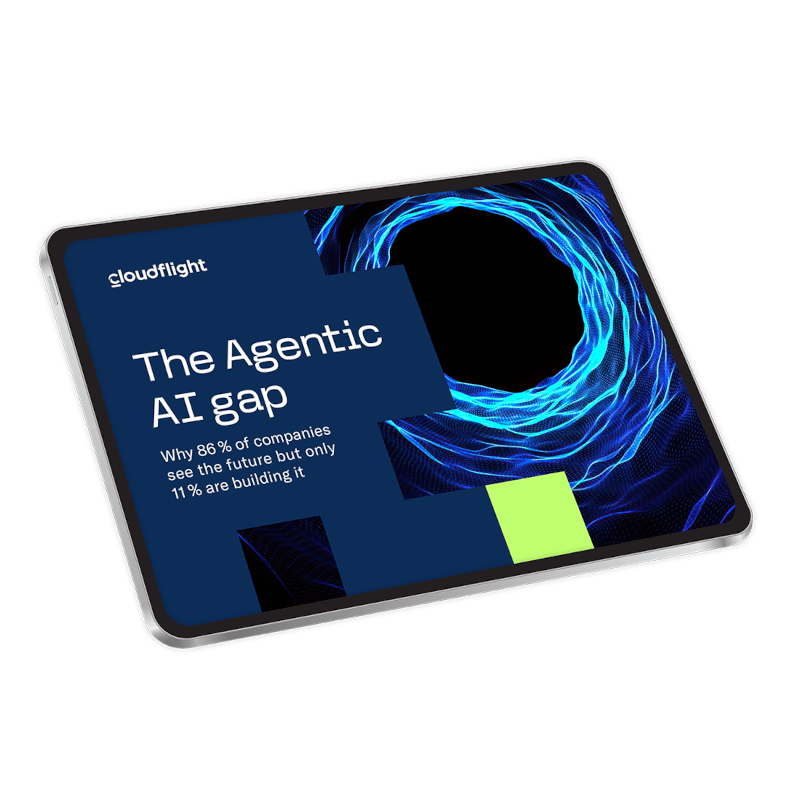
86% see Agentic AI’s future. Only 11% are building it.
At first glance, this 75-percentage-point gap between conviction and execution seems to come down to the usual suspects: technology limitations and budget constraints. This, however, is not the case. As our study reveals, the gap can be traced to three organizational paradoxes that keep even sophisticated companies stuck in perpetual experimentation.
The companies that solve these paradoxes are building operational advantages that compound with every quarter, but it’s not a matter of being smarter or better funded than competitors. They’ve simply figured out what the majority haven’t:
Agentic AI adoption is an organizational challenge disguised as a technical one.

The key takeaways
Cloudflight surveyed 150 executives across German enterprises to understand the state of Agentic AI adoption. Data shows that scaling Agentic AI depends on alignment, trust, and clear business cases—not on budget.
Budget is a red herring
Only 8% of responders cite budget constraints as the reason for their shortcomings. For every failure caused by budget constraints, six fail due to organizational misalignment.
Alignment creates a 6x scaling advantage
Companies with full cross-functional alignment are six times more likely to reach at least the scaling phase than those that describe themselves as only sufficiently aligned.
71% of businesses lack clear business cases
Without quantified ROI and defined success metrics, projects never leave the exploration phase. Among companies with clearly defined business cases, 86% reach the scaling phase, while it drops to 23% for companies with unclear business cases.
Culture blocks more than technology
Fear and trust issues rank as the number one future blocker, above seemingly fundamental issues such as missing strategy, budget, or technical limitations.
The industry gap is widening.
Energy companies scale at 72% while manufacturing reaches 25%. This organizational learning advantage compounds quarterly.
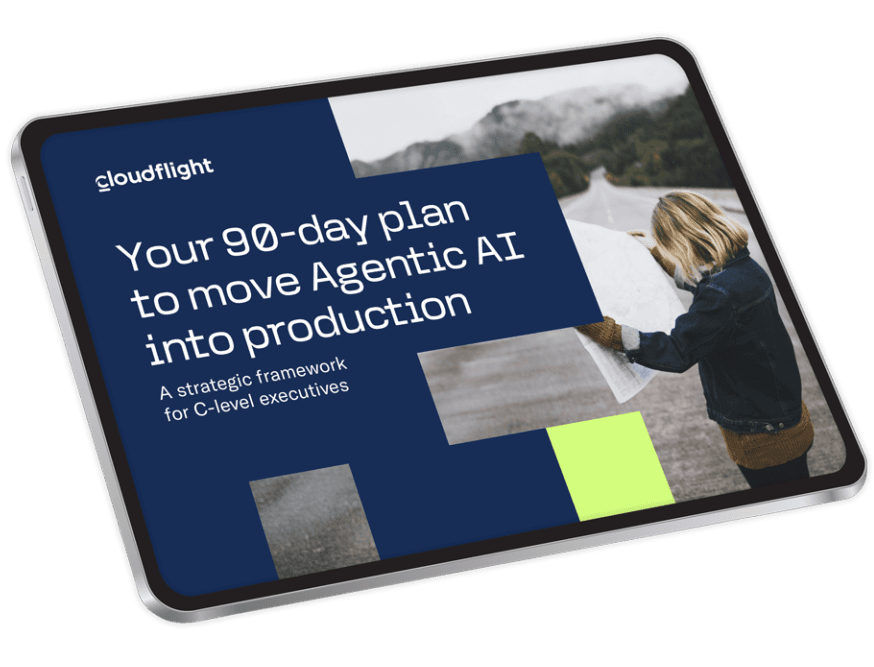
Your 90-day plan to move Agentic AI into production
You’ve seen the data: 86% of enterprises believe in Agentic AI’s transformative potential, but only 11% have reached advanced deployment. This executive framework translates the research into a practical 90-day plan- helping you align stakeholders, build clear business cases, and launch production pilots with confidence.

Short on time? See the content of our study in a nutshell
86% of German executives believe Agentic AI will be transformative. Only 11% have reached advanced deployment. Meanwhile, 57% claim advanced personal understanding of the technology—yet just 29% have a clear business case defined.
This means that knowledge alone doesn’t drive action. The gap isn’t informational; it’s organizational.
87% of executives say their company is open to experimentation. However, 57% admit employees are skeptical, and 59% acknowledge culture slows adoption more than technology. Only 11% have reached advanced deployment despite near-universal conviction.
This means that executive perception of readiness is systematically disconnected from organizational reality.
When Agentic AI initiatives fail, budget is very rarely the cause. Organizational misalignment accounts for 49% of failures —six times more. Yet 77% of companies are willing to commit 10%+ of budget to Agentic AI.
This means the money is available. The coordination infrastructure to spend it effectively isn’t.
71% of German enterprises lack a clear business case for Agentic AI. Without defined ROI, success metrics, and realistic timelines, every function—IT, finance, compliance, business— has legitimate reasons to withhold commitment.
This means most companies aren’t blocked by resistance. They’re blocked by ambiguity that makes resistance inevitable.
German enterprises focus on bounded automation in well-understood internal processes: decision support, monitoring, workflow orchestration. Customer-facing applications remain rare. Humans retain final authority in the vast majority of deployments. It’s a risk-conscious, incremental approach that builds competence before tackling complexity.
This means the path to advanced deployment in Germany runs through boring use cases first—and that’s actually the right call.
Companies with full cross-functional alignment scale at 51%. Partial alignment drops that to 13%. Poor alignment produces zero scaling success. Among fully aligned companies, 60% have very clear business cases—versus only 17% in poorly aligned ones. The four-fold advantage is structural, not coincidental.
This means alignment isn’t a soft factor. It’s the single biggest performance variable in this entire study.
51% of executives cite fear and trust as the primary future blocker, outranking missing strategy, organizational immaturity, compliance, and budget. 65% require human approval for every agent action. Cultural transformation takes 12-18 months minimum, while technical deployment takes 3-6 months.
This means sequencing matters: deploy culture change before technology, not after pilots stall.
Energy companies scale at 72%. Manufacturing and Healthcare reach only 25%. The gap comes down to process standardization, measurable ROI, and digital infrastructure maturity—not budget or talent. The organizational approaches that enable Energy’s dominance are transferable even when specific use cases aren’t.
This means lagging industries don’t need to copy Energy’s technology. They need to copy its governance model.
Six principles separate companies scaling successfully from those stuck in pilot purgatory: fix alignment first, build rigorous business cases, address cultural resistance early, design bounded autonomy, learn from sector leaders, and start despite imperfections. None require exceptional budgets or technical capability.
This means the path forward is known. Execution is the only remaining variable.