Study report

The Agentic AI gap


Why 86% of German enterprises

see the future but only 11% are building it 


New research on Agentic AI adoption reveals the organizational gaps
blocking German enterprises. Learn what 150 C-level executives
told us about alignment, culture, and scaling challenges.

Eighty-six percent of German enterprises believe Agentic AI will significantly impact their business, yet only 11% have moved beyond pilot projects to reach advanced deployment. 

At first glance, this 75-percentage-point gap between conviction and execution seems to come down to the usual suspects: technology limitations and budget constraints. This, however, is not the case. As our study reveals, the gap can be traced to three organizational paradoxes that keep even sophisticated companies stuck in perpetual experimentation. 

The companies that solve these paradoxes are building operational advantages that compound with every quarter, but it’s not a matter of being smarter or better funded than competitors. They’ve simply figured out what the majority haven’t: Agentic AI adoption is an organizational challenge disguised as a technical one. 
Executive summary

Cloudflight surveyed 150 executives across German enterprises to understand the state of Agentic AI adoption. What emerged was a story about organizational dysfunction and the companies learning to navigate it.

1. Budget is a red herring.

Only 8% of responders cite budget constraints as the reason for their shortcomings. For every failure caused by budget constraints, six fail due to organizational misalignment. 

2. Alignment creates a 6x scaling advantage.

Companies with full cross-functional alignment are six times more likely to reach at least the scaling phase than those that describe themselves as only sufficiently alignedFor poorly aligned companies, scaling success amounts to a round zero. 

3. 71% of businesses lack clear business cases. 

Without quantified ROI and defined success metrics, projects never leave the exploration phase. 

4. Culture blocks more than technology. 

Fear and trust issues rank as the number one future blockerabove seemingly fundamental issues such as missing strategy, budget, or technical limitations. 

5. The gap is widening.

Energy companies scale at 72% while manufacturing reaches 25%. This organizational learning advantage compounds quarterly. 

The key takeaway: German enterprises are failing to adopt Agentic AI because organizational friction overwhelms technical capability. In other words, the companies pulling ahead have solved coordination problems, not technical ones. 

The 86/11 reality check

Chapter 1

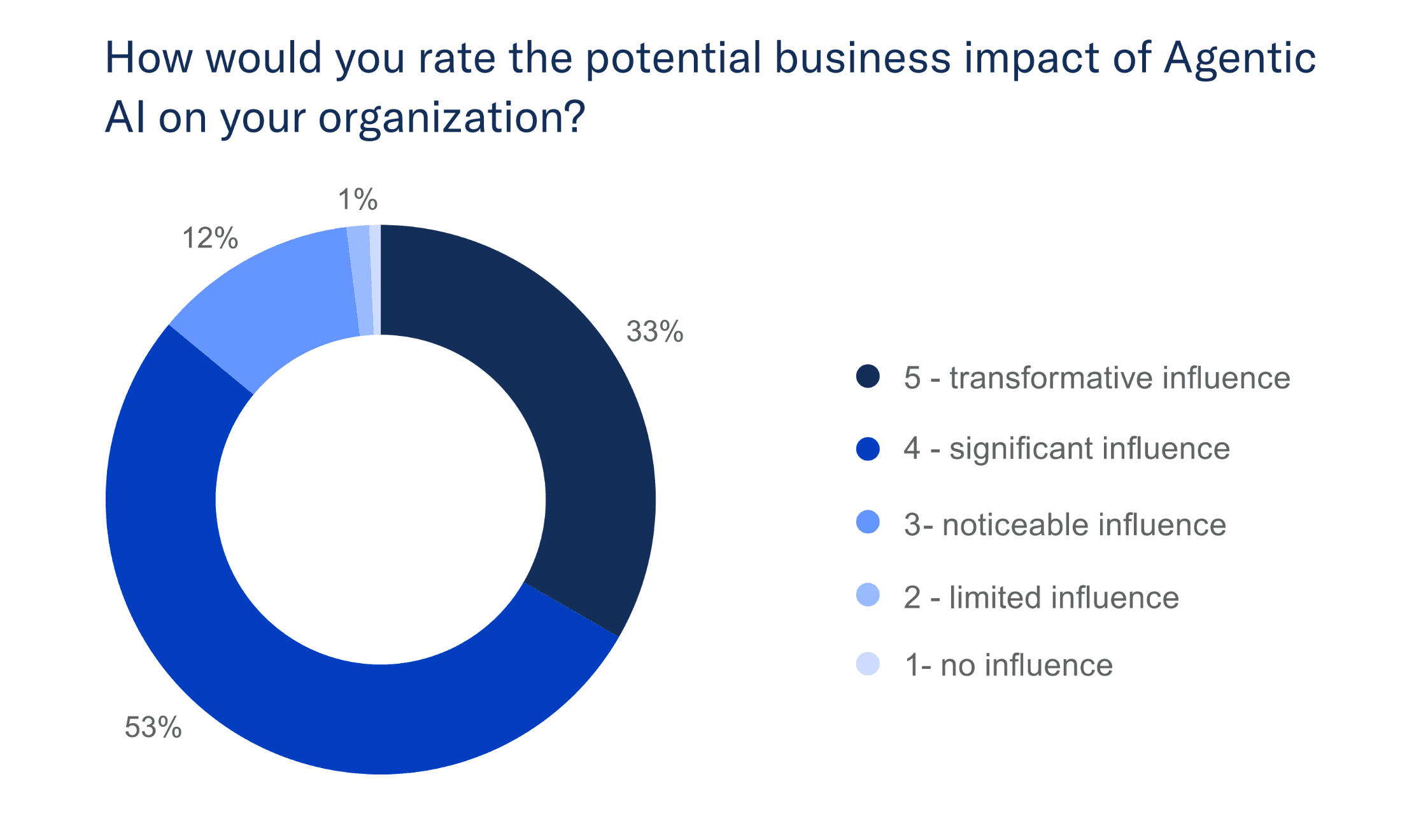
Let’s start with what German executives believe about Agentic AI. When asked about potential business impact, 86% rate it as significant or transformative. Considering organizational priority, 66% classify it as high or business-critical. These are decisive figures and a near-universal conviction that autonomous AI systems will reshape how enterprises operate

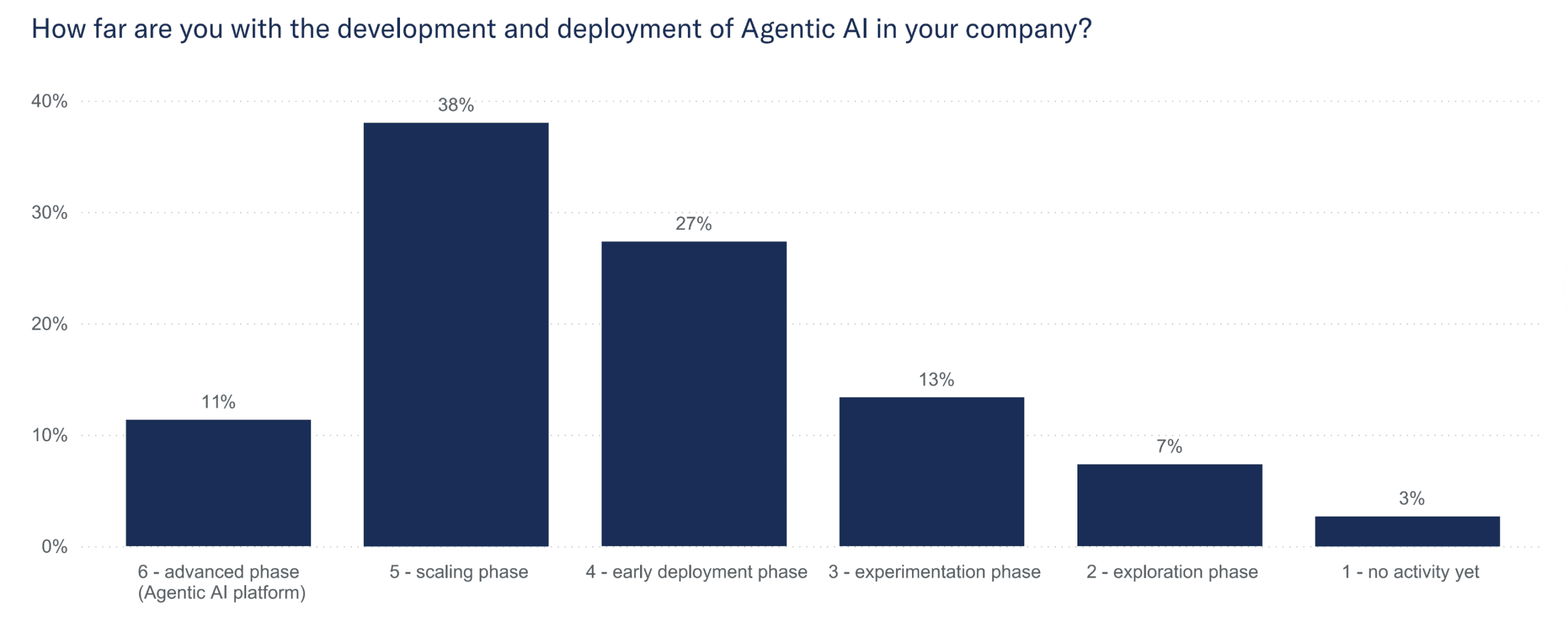
Now consider what those same enterprises are actually doing. Only 11% have reached the advanced implementation phase, meaning that they run a central Agentic AI platform that powers cross-functional autonomous workflows. Another 27% are in early deployment, with first agent workflows in limited production.

Next, 38% are scaling operationally across multiple business functions. A concerning 21% remain stuck in exploration or experimentation, running proof-of-concepts without clear paths to production. 

Companies that report themselves in advanced and scaling phases—together amounting to 49%— are effectively those that have moved beyond pilots. In isolation, this sounds better than the 11% mentioned above. Here’s the problem, though: when 86% believe something is transformative and 66% call it high priority, you’d expect coordinated action across the board. Instead, we observe fragmented execution and stalled pilots, which in the end result in a gap between strategic intent and operational reality. 

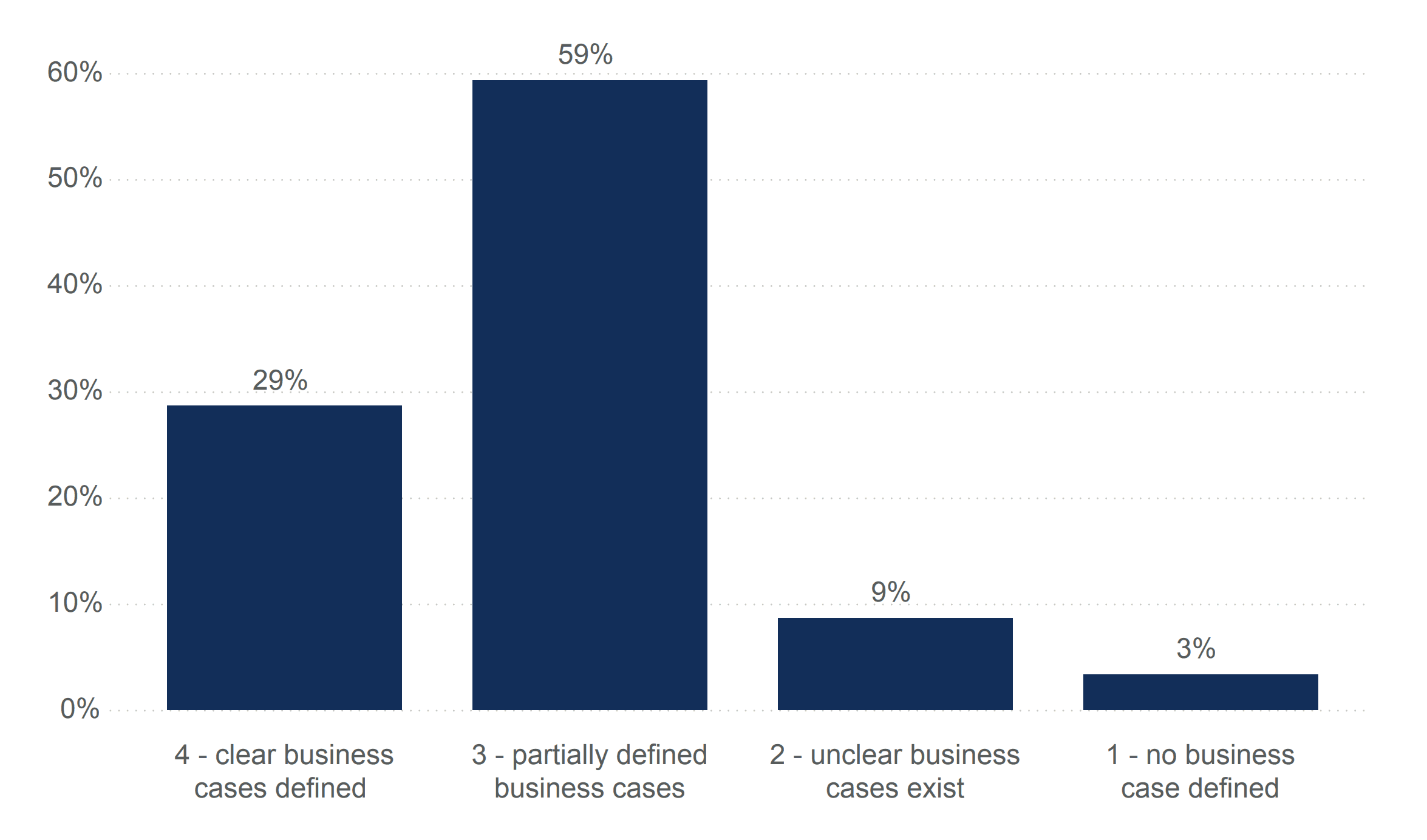
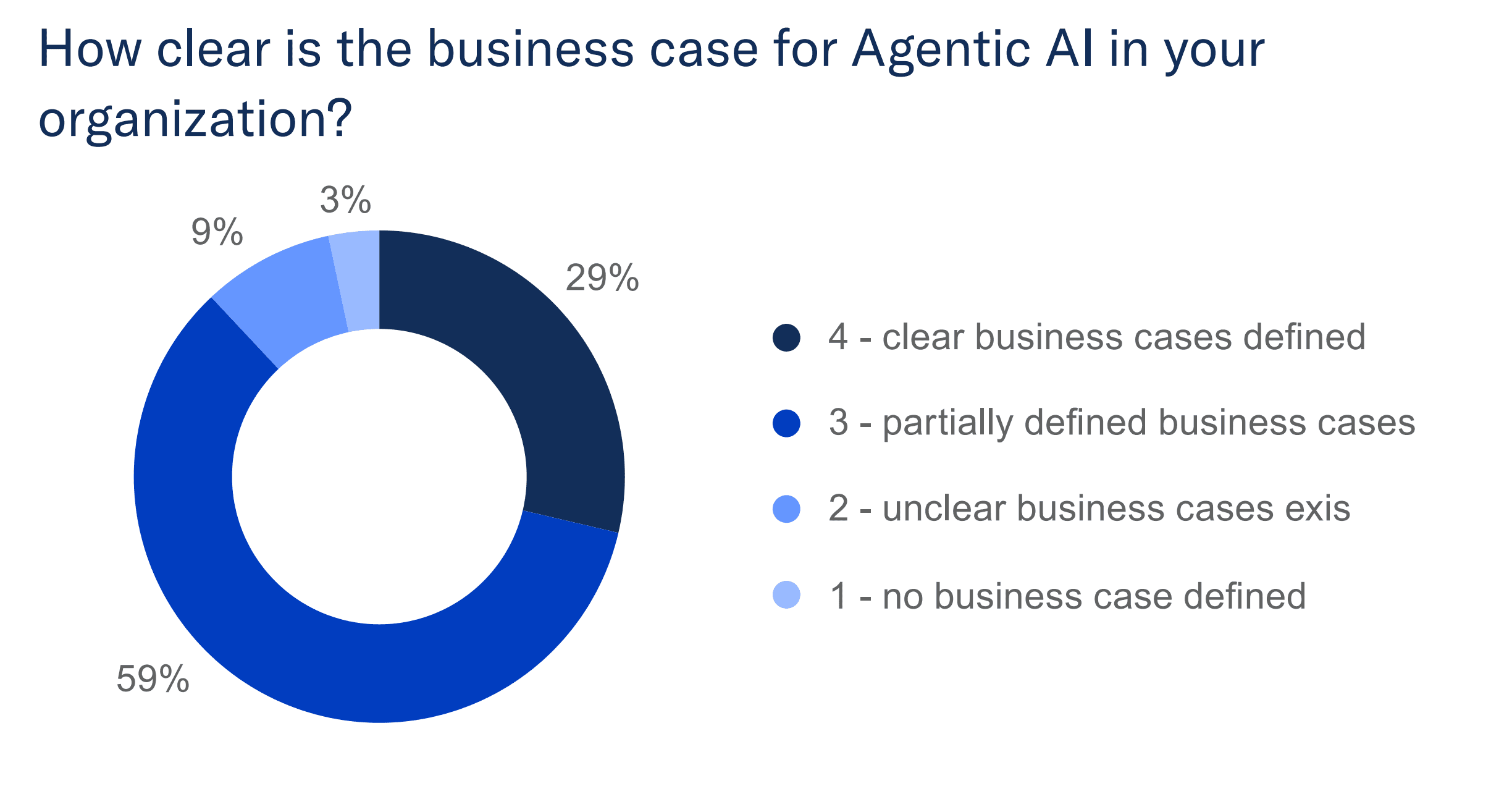
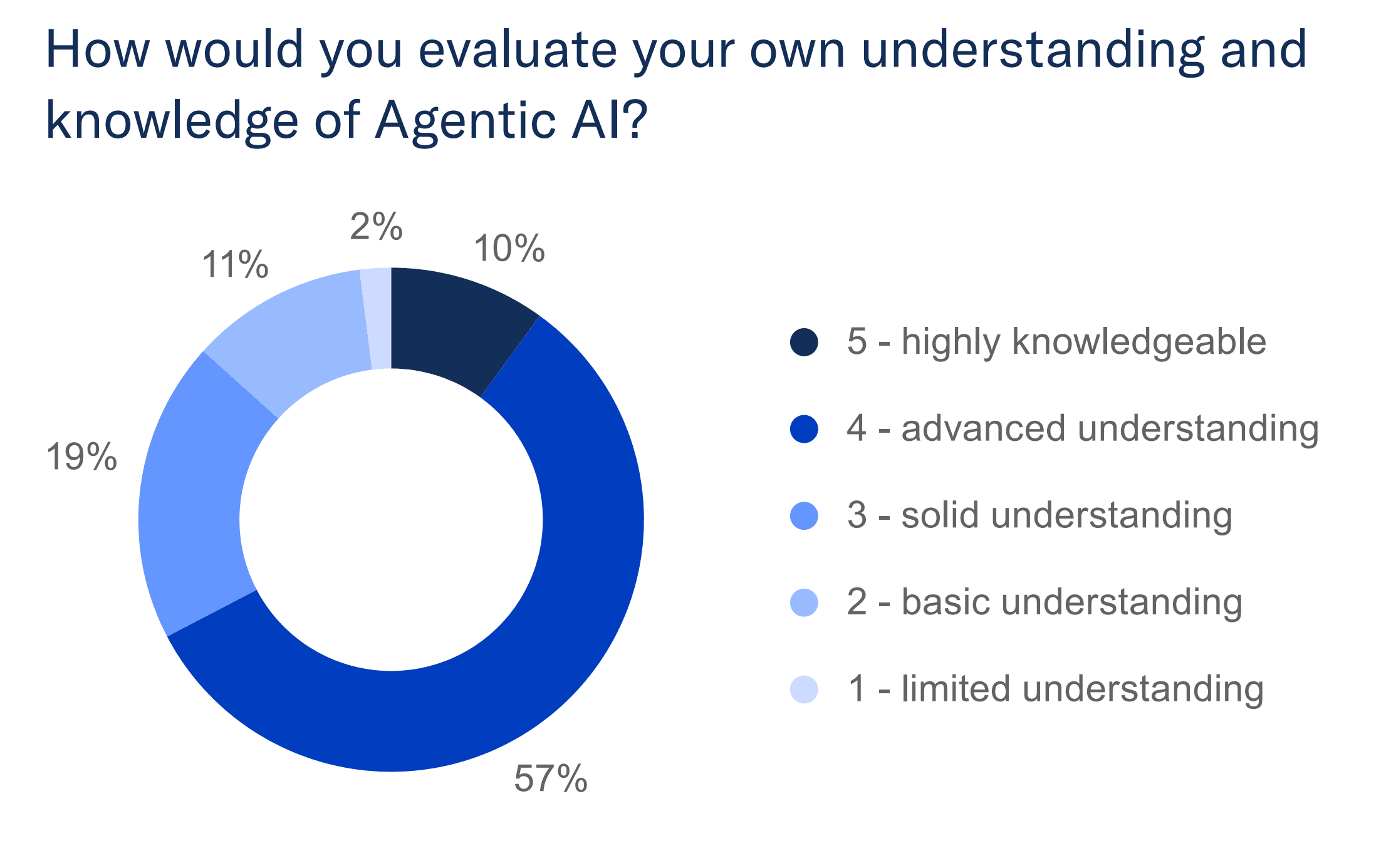
The average German executive describes themselves as fairly knowledgeable of Agentic AI. Fifty-seven percent of executives claim advanced understanding, while 10% rate themselves as highly knowledgeableAt the same time, only 29% have clear business cases defining ROI and success metrics. What companies end up with is high conviction and respectable understanding on one end, but weak business case clarity on the other. This combination produces exactly what you’d expect: lots of belief but limited action.

This study tellthe story about companies that see the potential of Agentic AI but can’t translate understanding into organizational execution. So, what exactly is blocking the translation from belief to action? 

Key insight #1

86% of German executives believe Agentic AI will be transformative. Only 11% have reached advanced deployment. Meanwhile, 57% claim advanced personal understanding of the technology—yet just 29% have a clear business case defined.

This means that knowledge alone doesn’t drive action. The gap isn’t informational; it’s organizational.

Why smart companies stay stuck

Chapter 2

The Agentic AI adoption gap exists because of three structural contradictions. As we’ve learned while conducting the study, these aren’t just correlation patterns or statistical quirks. Rather, they’re genuine organizational paradoxes where two incompatible realities coexist. They create friction that overwhelms even well-resourced enterprises. 

Paradox one: the optimism-inaction gap 

The average German executive doesn’t need convincing that Agentic AI is the next big thing.  Eighty-six percent of responders believe Agentic AI will have significant or transformative impact and 66% rate it as high or business-critical priority. When you believe something will transform your business and rate it as high priority, the expected behavior is execution. 

Instead, only 11% have reached advanced deployment and 21% percent are still exploring or experimenting: they’re running pilots without clear production paths. There’s clearly a massive disconnect between stated belief and observable action—but why is that? 

Our experts believe that the main issue is belief failing to translate into the organizational coordination required for execution. Executives genuinely believe Agentic AI matters, but belief alone doesn’t create cultural readiness or clear ownership. Without those elements, conviction produces endless strategic discussions and stalled pilots, not deployed systems. 

The companies moving the fastest are the ones that solved the coordination problem, turning conviction into action. 

Paradox two: the innovation identity crisis

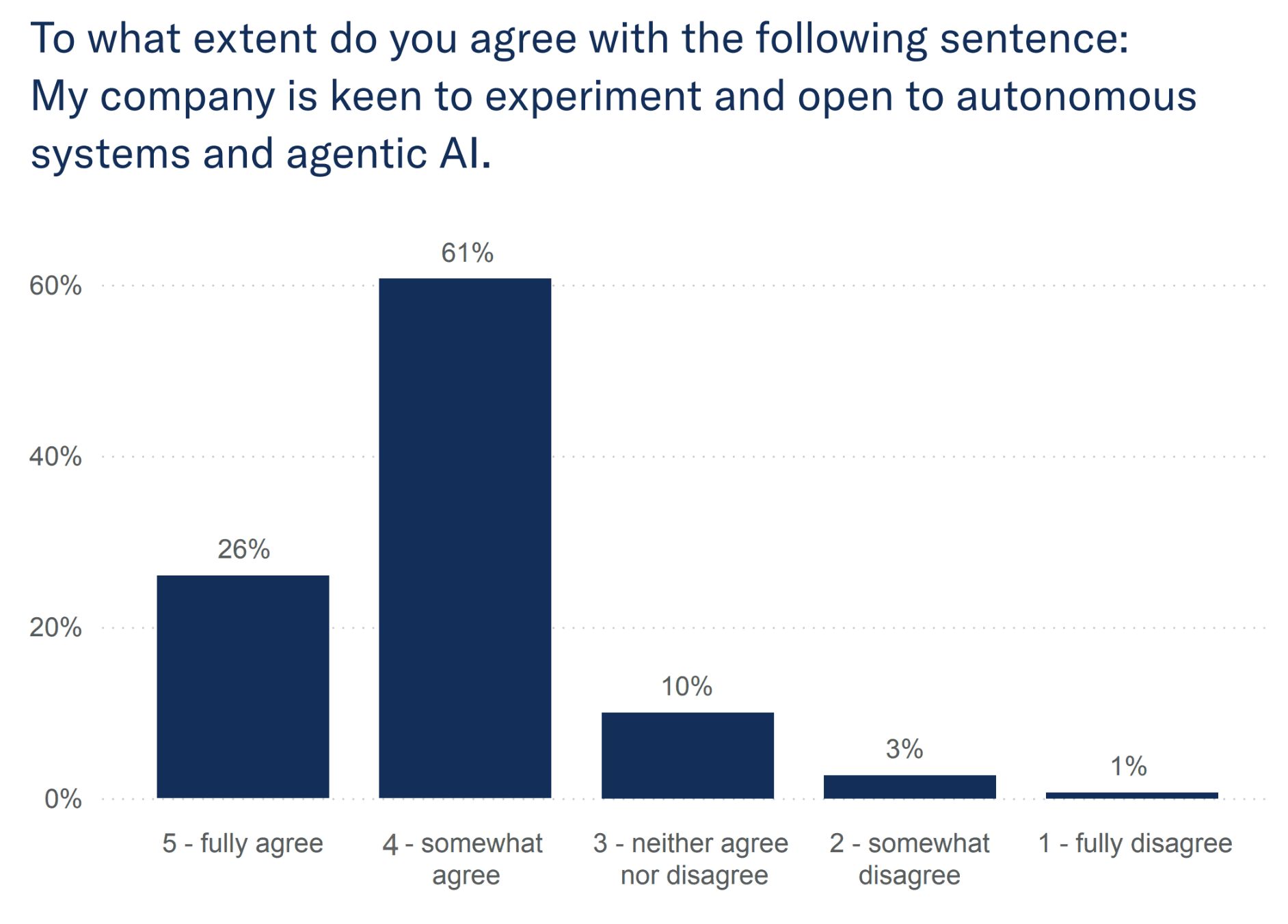
The second contradiction is more subtle but equally revealing. When asked whether “my company is open to experimentation with autonomous systems and Agentic AI,” 87% of executives agreeHowever, when asked if “employees in my company are skeptical about Agentic AI” and “cultural and psychological factors slow Agentic AI adoption more than technical limitations,” the majority (57% and 59% respectively) agreesOn a company level, you can’t simultaneously be “open to experimentation” AND have skeptical employees AND acknowledge culture is the main blocker. Something just doesn’t add up.

The most likely explanation is a disconnect between leadership and the rest of the organization. Executives who champion Agentic AI naturally assume the organization shares their enthusiasm, but they haven’t tested that assumption against organizational reality. They failed to consider the middle managers who resist workflow changes, the employees who fear job displacement, and the business units that don’t see how autonomous systems serve their objectives.

André HolhozinskyjCloudflight CEO

The gap between executive perception and organizational capacity reveals itself in deployment phase. Companies often launch pilots with executive sponsorship, hit cultural resistance during rollout, and stall. Leadership attributes failure to “insufficient readiness” or “change management challenges,” rarely recognizing that their self-assessment of innovation readiness was flawed from the start. 


Here’s the harsh but necessary takeaway for C-level executives: your perception of innovation readiness is likely unreliable. 


If 57% of executives believe that their employees are skeptical, C-level enthusiasm alone won’t drive adoption. You need active cultural transformation, not declarations of innovation-friendliness. The companies pulling ahead acknowledge the gap and invest in change management from day one, not after pilots stall. 

Paradox three: the ownership-authority mismatch

The third contradiction is structural. In 67% of German enterprises, IT owns Agentic AI. More precisely, it’s typically the job of either the Chief Innovation Officer (CIO) or Head of IT. At first glance, this allocation of ownership seems logical: since AI requires technical infrastructure, system integration, and engineering capability, who better to own it than IT? 

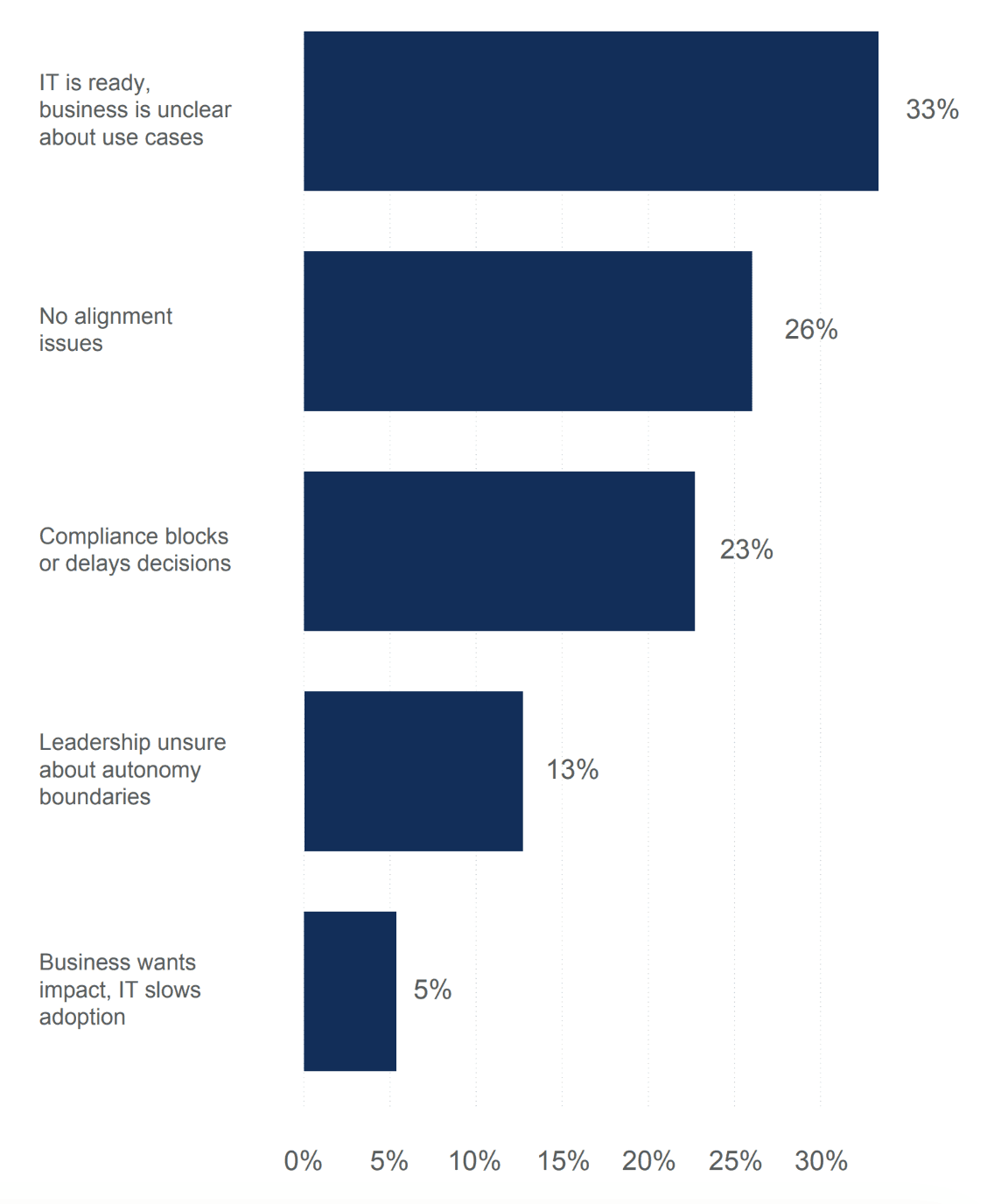
Here’s the problem: when asked “where do you see the biggest alignment gap,” 33% of executives said that “IT is ready, but business is unclear on use cases.” Twenty-three percent cite compliance blocks or delays. Only 5% say “business wants impact, IT slows adoption.” 

The main blocker, then, is that business doesn’t see use cases. Realistically speaking, is it something that IT can solve? Not really. IT can build technical capability, implement infrastructure, and deploy systems in the end. What the department can’t do is create business demand or drive cross-functional adoption. IT ownership may work for infrastructure projects, but Agentic AI is a full-blown business transformation. Ownership must match the scope. 

This creates what we’re calling the triangle of paralysis: IT builds capability while business doesn’t engage. Business wants impact while IT focuses on infrastructure. Compliance needs assurance but neither IT nor business prioritizes it. All three functions operate independently, creating coordination deadlock. 

Who should own Agentic AI, then? In our opinion, this shouldn’t be a function but a role: someone who can align IT capability, business demand, and compliance requirements. In most organizations, that’s either the CEO (for strategic transformation), CDO (for cross-functional digital initiatives), or a dedicated transformation leader reporting directly to the CEO.  

The companies moving fastest have solved this structural problem. The majority haven’t recognized it yet. 

Key insight #2

87% of executives say their company is open to experimentation. However, 57% admit employees are skeptical, and 59% acknowledge culture slows adoption more than technology. Only 11% have reached advanced deployment despite near-universal conviction.

This means that executive perception of readiness is systematically disconnected from organizational reality.

The budget red herring

Chapter 3

The budgetary section of this study is where our initial assumptions and hypotheses were challenged the most. When German enterprises discuss Agentic AI adoption challenges, budget frequently dominates the conversation. “We need more funding,” “finance won’t approve the investment,” “once budget is allocated, we’ll move forward” is what we often hear. It sounds plausible because AI infrastructure and talent aren’t cheap. The data, however, tells a different story. 

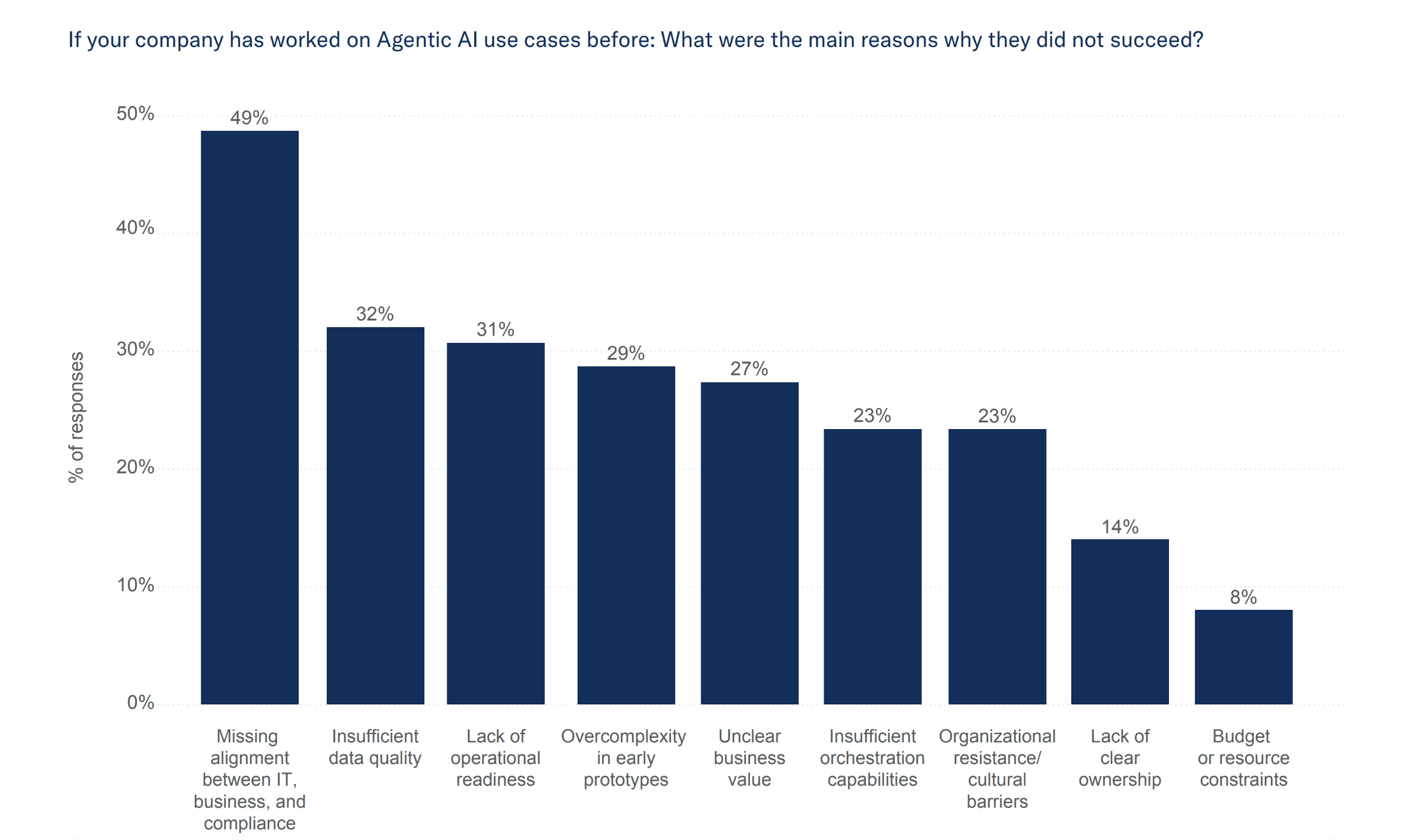
When executives whose Agentic AI initiatives failed were asked “what were the main reasons,” only 8% cited budget or resource constraints. Forty-nine percent cited misalignment between IT, business, and compliance: six times higher than budget. Thirty-two percent cited insufficient data quality. Thirty-one percent cited lack of operational readiness. Twenty-nine percent cited overcomplexity in prototypes. Budget ranks fifth out of nine failure causes. 


For every company that failed due to budget constraints, six failed due to organizational misalignment. 


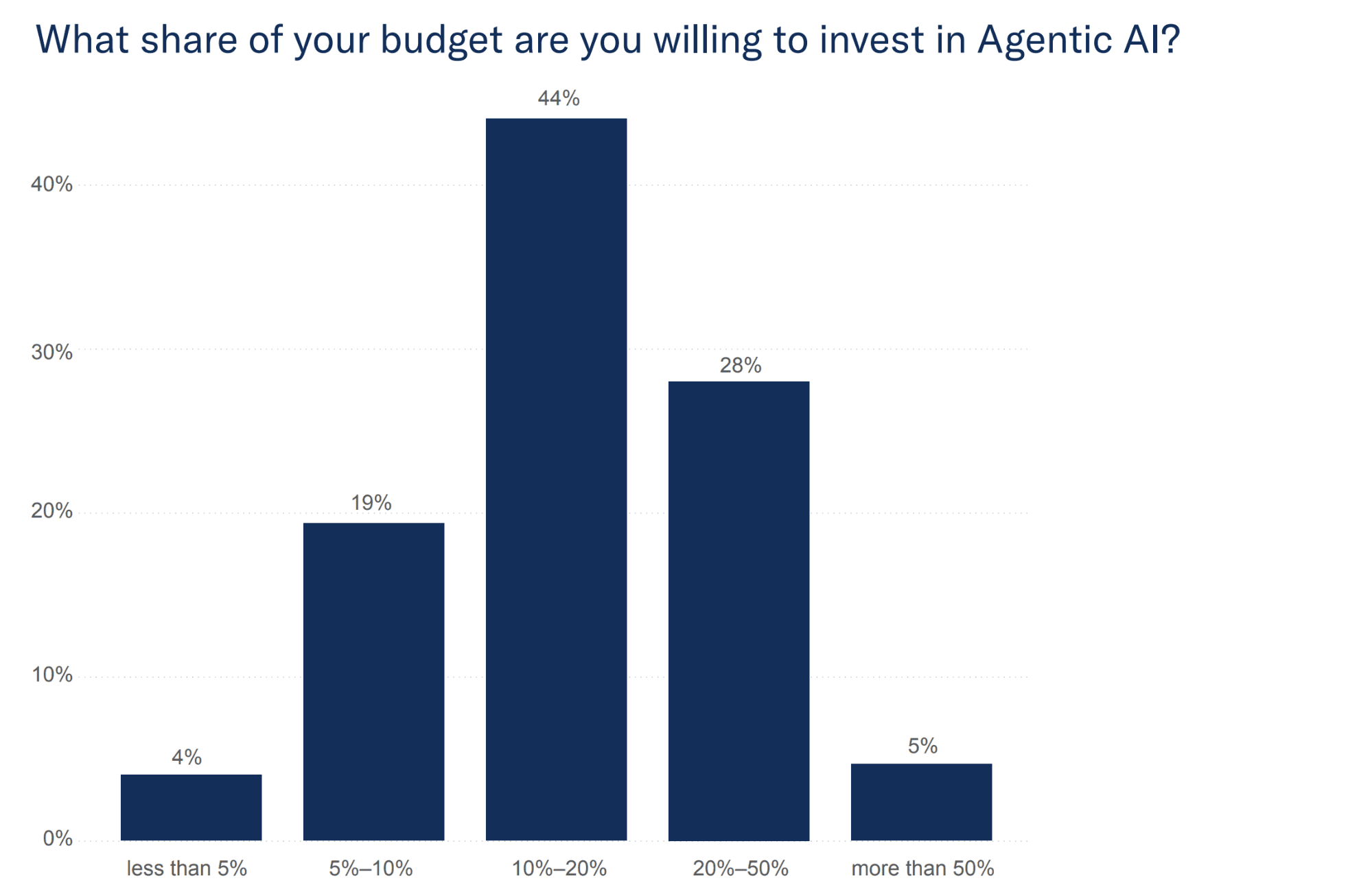
Now consider investment willingness. When asked “what share of your budget are you willing to invest in Agentic AI,” 77% indicate they’ll commit 10% or more. Thirty-three percent will commit 20% or more. Only 4% are limited to less than 5% of budget. So, the money is available. Companies are ready to spend.

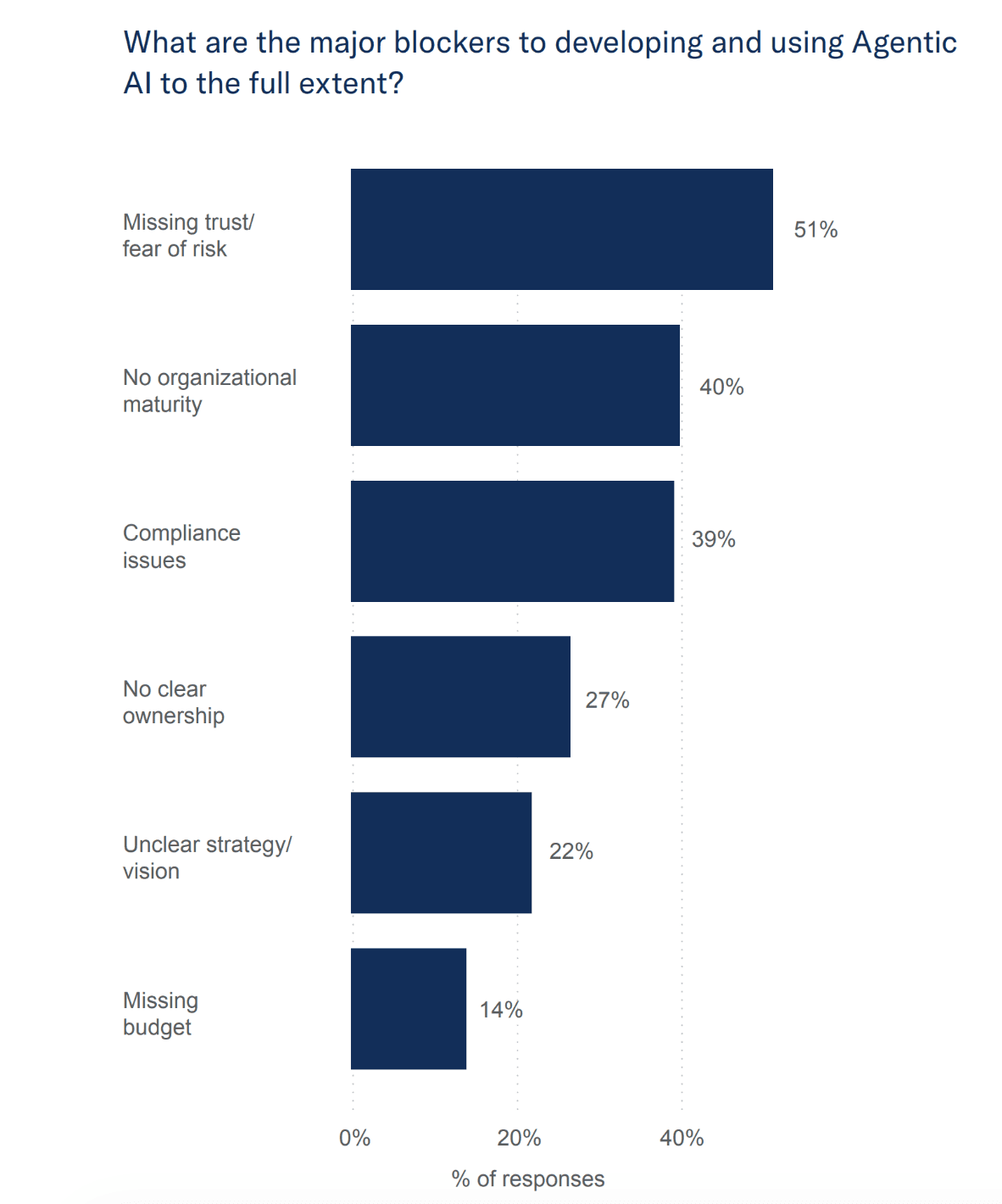
The surprises go further. When asked about future blockers and anticipated challenges, budget ranks fifth again. Fifty-one percent cite fear and trust issues as the primary future blocker. Forty percent cite missing strategy or vision. Forty percent cite organizational immaturity. Twenty-six percent cite compliance issues. Only 14% cite budget.

The convenient excuse 

Budget is neither the main cause of past failures nor the primary anticipated future blocker. So why does it dominate organizational conversations? 

We can’t answer this question for sure, but we can give you our “fly on the wall” perspective. Budget is tangible and quantifiable, which makes it politically safe to discuss. Saying “we need more budget” is straightforward and implies the problem is external: finance won’t approve, economic conditions are uncertain, and so on. Saying “we can’t coordinate across IT, business, and compliance” or “our culture isn’t ready for autonomous systems” is uncomfortable. It implies internal organizational dysfunction. 

Here’s what this means for enterprises waiting for budget approval to advance Agentic AI initiatives: you’re likely solving the wrong problem. The companies pulling ahead aren’t spending dramatically more, but they’re coordinating better. They’ve established cross-functional ownership and built cultural readiness. Budget follows those foundations. The conversation needs to shift from “can we afford this?” to “can we coordinate around this?” The answer to the second question determines success far more than the answer to the first. However, coordination requires a foundation that most companies lack. 

Gernot MolinCloudflight CTO

Key insight #3

When Agentic AI initiatives fail, budget is very rarely the cause. Organizational misalignment accounts for 49% of failures – six times more. Yet 77% of companies are willing to commit 10%+ of budget to Agentic AI.

This means the money is available. The coordination infrastructure to spend it effectively isn’t.

The missing foundation: business case clarity

Chapter 4

If budget isn’t the blocker and organizational alignment matters most, what specifically prevents alignment? One factor rises above others: business case clarity. 

Our study shows that only 29% of German enterprises have clear business cases for Agentic AI deployment. In other words, seventy-one percent lack clarity on ROI, implementation timelines, or success metrics. This is a massive gap and the foundation that’s missing from most Agentic AI strategies. 

Think about what happens when business case clarity is absent. Finance won’t approve budget allocation without quantified ROI projections. Business units won’t prioritize agent deployment without defined success metrics. IT can’t design systems without understanding business requirements. Compliance can’t assess risk without knowing intended use cases and autonomy boundaries. Every function has legitimate reasons to withhold commitment. 


Without a clear business case, Agentic AI remains perpetually in exploration phase: it’s strategically interesting but operationally undefined. 


Pilots run indefinitely because no one can definitively answer “did this work?” Projects restart repeatedly because success criteria keep shifting. Executive enthusiasm generates activity and busy work, but not actual progress. 

Here’s what a clear business case should mean in real-world scenarios: 

1. Quantified ROI with specifics

We aren’t talking about “efficiency gains” or “productivity improvements” because those are aspirations, not business cases. A clear business case should read, for example, “20% reduction in incident resolution time, translating to €400,000 annual savings, achieved within six months of deployment.” Specific metrics, specific value, and specific timeline are the three commandments here.

2. Defined success metrics that cross-functional stakeholders agree on

 IT might define success as “agents deployed without system failures.” Business might define success as “process cycle time reduced by 30%.” Finance might define success as “hard cost savings exceeding implementation costs within 18 months.”

In a vacuum, there’s nothing wrong with any of them. However, if these metrics aren’t aligned before deployment, you don’t have organizational agreement. You have three different projects masquerading as one. 

3. Realistic timeline expectations

Many enterprises expect three-month transformations. Bluntly put, that’s completely unrealistic. Real-world timelines for enterprise Agentic AI deployment are as follows: 90-180 days for properly scoped pilots and 6-12 months to scale operationally. Cultural transformation takes longer; it’s typically a 12-18 month-long project at a minimum.

A clear business case includes honest timeline assessment, not fantasy projections designed to secure approval. 

4. Risk assessment with mitigation strategies

What could go wrong? How do we detect issues early? What’s the fallback if autonomous agents make incorrect decisions? What compliance implications exist? A clear business case addresses these questions upfront, not when problems emerge in production. 

Why do 71% of companies lack this clarity? There are several reasons: 

1. They don’t have the methodology for selecting high-confidence use cases.

Instead of a systematic evaluation of processes by repeatability, volume, stakes, and measurability, they chase whatever sounds strategically exciting. For example, they might go for customer-facing applications that sound impressive but introduce complexity. Instead, they should focus on cases such as internal workflow automation, which sounds boring but delivers faster ROI.

2. They don’t know how to quantify agent impact.

Traditional productivity metrics don’t cleanly map to autonomous systems. For instance, how do you measure the value of 24/7 monitoring that prevents incidents before they occur? How do you attribute cost savings when agents work alongside humans in hybrid workflows? Without frameworks for quantification, companies resort to vague claims that finance won’t approve.

3. They overestimate transformation requirements.

 Many assume that Agentic AI requires process redesign, data lake modernization, and organization-wide change management before any pilot. This creates paralysis. In reality, you can start with bounded automation in well-defined processes. This will allow you to quickly demonstrate value and then expand iteratively.

4. They underestimate what’s achievable.

Conversely, some companies assume that agents can only handle simple and repetitive tasks. They don’t realize autonomous systems can, for instance, coordinate multi-step workflows, make contextual decisions, and even operate across system boundaries. This leads to underwhelming use case selection that fails to generate executive attention.

5. They have misaligned definitions of success between functions. 

This is perhaps the most common factor. IT tends to define technical success, business: operational success, finance: financial success, and compliance: risk success. No one aligns these definitions before deployment, so every stakeholder evaluates results against different criteria and reaches different conclusions.

6. They treat Agentic AI as just another technology rather than a virtual employee.

As a result, they deploy agents without clearly defining roles, responsibilities, escalation paths, or performance expectations. No one asks basic questions, such as how will it be trained, evaluated, and improved over time? Companies that succeed think of agents as junior hires at first, with scoped authority, clear goals, and supervision, and then expand autonomy as confidence and capability grow. 

Building clear business cases doesn’t need to be difficult if the right foundations are in place. All that’s needed is a structured methodology for use case selection, ROI quantification, and cross-functional alignment on success metrics. Companies that systematically address these gaps move from belief to execution. Those that don’t tend to remain stuck debating whether to start. 


Key insight #4

71% of German enterprises lack a clear business case for Agentic AI. Without defined ROI, success metrics, and realistic timelines, every function—IT, finance, compliance, business—has legitimate reasons to withhold commitment.

This means most companies aren’t blocked by resistance. They’re blocked by ambiguity that makes resistance inevitable.